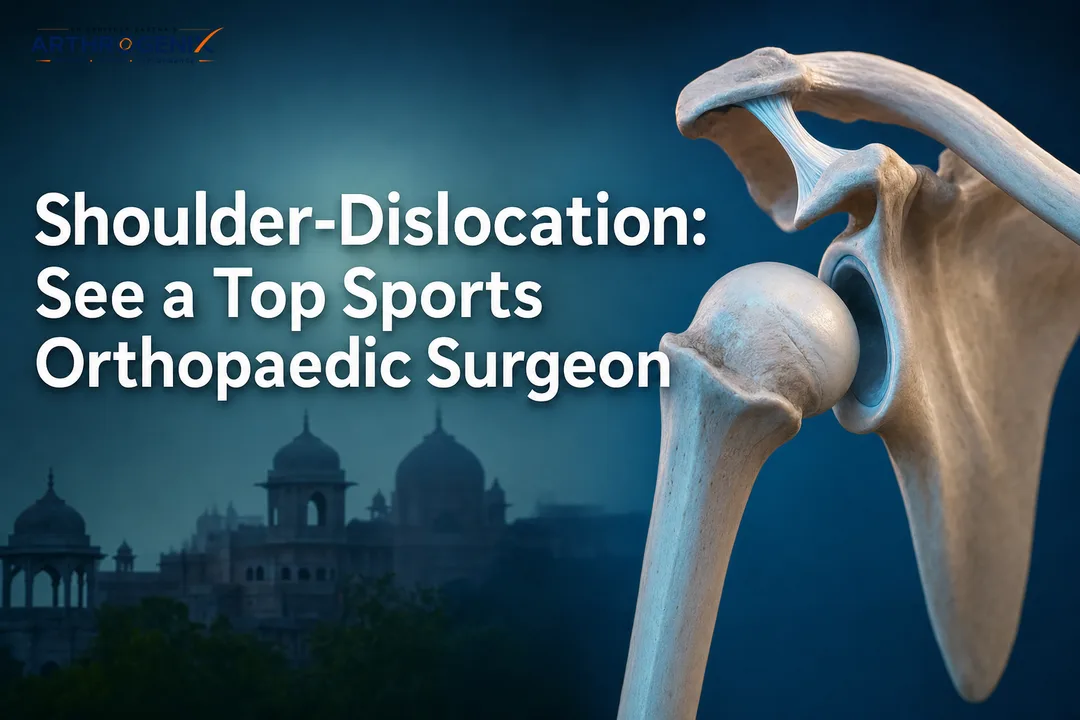
Shoulder-dislocation can stop your match in a second and linger long after the fall. If you suspect a first-time or repeat episode, a sports orthopaedic surgeon is your best ally for rapid pain relief and a safe return to action. In this guide, we explain what shoulder-dislocation really means, how we diagnose and treat it in Jaipur, and when to move fast.
What a shoulder-dislocation really is
Your shoulder is a ball-and-socket joint. In a dislocation, the humeral head (ball) slips out of the glenoid (socket). Most athletes experience an anterior dislocation, where the ball moves forward after a tackle, fall, or overhead motion. Posterior dislocations are less common and often follow seizures or electric injuries. Either way, prompt reduction and stability-focused rehab matter.
Why does it happen? In many cases, the force tears the labrum (the rim of cartilage that deepens the socket) and stretches the capsule. As a result, the joint can feel loose or unreliable. The shoulder is also the most frequently dislocated major joint, which explains why we see it so often in contact and overhead sports.
Typical signs include sudden shoulder pain, visible deformity, loss of contour, and inability to move the arm. However, some athletes only report a sense of “slipping out” followed by rapid self-reduction. Notably, recurrent subluxations can be subtle yet damaging over time.
When to See a Sports Orthopaedic Surgeon
Seek urgent care if your shoulder looks deformed, you cannot lift the arm, or you feel numbness or tingling in the hand. Importantly, do not try home maneuvers; you risk nerve injury. Instead, immobilize the arm, apply ice, and head to the emergency department or our clinic for guided reduction.
After urgent care, you still need a focused plan. In fact, first episodes in young athletes carry a high risk of repeat instability. Early evaluation helps you decide between structured rehabilitation and stabilization surgery. Above all, the goal is a strong, reliable shoulder that tolerates your sport.
- Red flags: persistent numbness, weak grip, or cool hand
- High-risk sport: rugby, kabaddi, wrestling, overhead throwing
- High-risk profile: younger athletes, contact sports, prior dislocations
According to the AAOS OrthoInfo on shoulder dislocation, reduction followed by a short period of immobilization and progressive therapy is a standard pathway. Furthermore, anterior dislocation is by far the most common pattern, which guides imaging and treatment decisions.
Diagnosis and treatment options at ArthroGenix
At ArthroGenix in Jaipur, we start with a careful history of the injury mechanism and a targeted examination for labral injury, capsular laxity, and rotator cuff strength. For clarity, we pair X-rays with MRI or MR-arthrogram when instability, labral tears, or bone loss are suspected. This precise mapping helps you avoid delays and re-injury.
How a Sports Orthopaedic Surgeon Assesses Instability
First, we confirm the direction of instability and check for nerve symptoms. Next, we evaluate soft-tissue and bony damage, including Hill-Sachs and glenoid defects. In addition, we review your sport, position, and season timing to personalize care. Crucially, our assessment aligns your goals with the safest path back to play.
Non-surgical care and rehabilitation
Many first-time dislocations respond well to a structured plan. Initially, we focus on pain control, swelling reduction, and gentle protected motion. Then we progress to scapular control, rotator cuff activation, and closed-chain stability drills. Importantly, we track your progress with return-to-throw or contact-readiness criteria, not just the calendar.
Evidence-based pathways matter. For instance, early supervised stability work reduces the risk of repeat episodes compared with rest alone. As a result, you regain confidence, strength, and proprioception before sport-specific loading. Notably, we coordinate with your coach or trainer so that rehab translates to the field.
Shoulder arthroscopy and stabilization surgery
Some patients face high recurrence risk due to age, sport demands, or structural damage. In those cases, arthroscopic stabilization restores labral function and tightens the capsule. Consequently, the ball stays centered in the socket under speed and contact. When significant bone loss exists, we may discuss bone-block procedures for durable stability.
Capsulolabral repair (Bankart) vs. Latarjet
For soft-tissue Bankart lesions without major bone loss, arthroscopic repair reattaches the labrum and tightens the capsule. Alternatively, in cases with substantial glenoid bone loss or large off-track Hill-Sachs lesions, a Latarjet transfers the coracoid to expand the socket surface and resist re-dislocation. Therefore, surgical choice depends on precise measurements, your sport, and your goals.
As outlined in the StatPearls overview of anterior shoulder dislocation, younger collision athletes experience higher recurrence risk after first-time dislocation, which often tips the decision toward stabilization. That said, we individualize recommendations after clear discussion of benefits, risks, and timelines.
Recovery, prevention, and returning to sport
Timelines vary by pathology and sport. However, most non-surgical pathways follow a staged return after strength, control, and contact-readiness tests. Similarly, surgical patients progress through healing, strength, and performance phases before full clearance. In short, we sign off when your shoulder shows both resilience and skill readiness.
To prevent recurrence, we build a foundation of scapular control, rotator cuff endurance, and kinetic-chain strength. Moreover, we coach landing mechanics, tackle technique, and load management. Importantly, technique and timing changes often protect the shoulder more than added braces alone.
Taping, technique, and training adjustments
Supportive taping or bracing can improve proprioception in the short term. Nevertheless, we pair it with coaching on safe reach-back positions and contact angles. For throwers, we refine cocking range and deceleration control. For contact athletes, we drill shoulder-safe tackle entries and fall strategies. Consequently, you improve both performance and protection.
As MedlinePlus notes in its shoulder dislocation overview, appropriate reduction, brief immobilization, and targeted rehabilitation support a solid recovery. We agree. Therefore, we align your plan with sport demands, not just generic milestones.
Why choose ArthroGenix for Jaipur sports orthopaedic care
We treat athletes, professionals, and active seniors who want dependable joints and clear guidance. At ArthroGenix, Dr. Abhishek Saxena brings advanced arthroscopy skills, including shoulder arthroscopy Jaipur, rotator cuff repair, and instability surgery. In our experience, precise diagnosis and a disciplined plan shorten the path back to play and reduce avoidable setbacks.
Our team also manages complex knee and ligament problems. For example, we handle ACL reconstruction Jaipur, PCL reconstruction, meniscus repair, knee arthroscopy Jaipur, and knee replacement Jaipur with an emphasis on joint preservation. Furthermore, we support cartilage injury treatment, ligament injury treatment, and comprehensive sports medicine Jaipur under one roof.
If you are comparing options for a shoulder surgeon Jaipur or an arthroscopy surgeon Jaipur, look for clear communication, measured return-to-sport criteria, and transparent outcome tracking. Importantly, the best orthopaedic surgeon in Jaipur for you is the one who matches your sport, injury pattern, and expectations. Therefore, we welcome second opinions and shared decision-making at every step.
In clinic, we frequently meet athletes who “felt it slip” multiple times before seeking help. Typically, a targeted stabilization program or arthroscopic repair restores trust in the joint. We also coordinate with physiotherapists to ensure the work you do in the gym shows up on the field. As a result, your confidence grows alongside your numbers.
First-hand insight: At ArthroGenix, we often see patterns repeat—insufficient early rehab, rushed return, and avoidable recurrence. When we reset the plan with staged goals and sport-specific drills, athletes regain both control and courage. That measured approach, more than any brace, keeps shoulders in the socket when it counts.
Here’s a quick recap of what to do right after a suspected dislocation:
- Stop play immediately and support the arm in a comfortable position.
- Apply ice to control pain and swelling.
- Avoid forced “self-reduction.” Go to urgent care for guided management.
- Schedule follow-up with an orthopaedic surgeon in Jaipur for imaging and planning.
- Begin a stability-focused rehab or discuss surgical stabilization if risks are high.
We keep treatment honest. Not every case needs surgery, and not every athlete should push through a season. Results vary based on age, sport, tissue quality, commitment to rehab, and the presence of bone loss. Nevertheless, with a precise plan and strong follow-through, most people return to what they love without constant fear of re-dislocation.
If you need individualized guidance or a second opinion, reach out to ArthroGenix. Our team will help you weigh non-surgical and surgical paths, set smart timelines, and coordinate a return-to-sport plan that protects your future.
To conclude, if you or a teammate is dealing with shoulder-dislocation, a sports orthopaedic surgeon can clarify risks, map the right rehab, and, when needed, stabilize the joint for the long run. We’re here to help you move well, compete confidently, and protect the seasons ahead.
Leave a Reply